
If you’ve spent any time online trying to optimize your personal finances, you’ve probably come across Bankrate at some point. Their core focus is on comparing rates, whether they’re mortgage rates, credit card interest rates, or high-yield savings account APYs. And they’re actually an extremely useful resource for up-to-date comparisons.
But relying on Bankrate alone for product research is unwise. Their product database is pretty extensive, but in certain cases, it may not be enough. Or maybe you want something geared more toward quick research, in which case Bankrate could be too complex.
Whatever your reason, here are some of the top Bankrate alternatives out there.

At a Glance
| Best For | Pros | Cons | |
| BestMoney | Quick research | Broad product coverage Editorial ratings and reviews Informative articles on personal finance | No user reviews Provider options are limited No side-by-side comparisons |
| NerdWallet | Financial education | Broad product coverage Editorial ratings and reviews Plenty of calculators | No user reviews No side-by-side comparisons Potentially confusing UI |
| WalletHub | Credit cards | Great for credit card comparison Extensive filtering Side-by-side comparisons | Potentially overwhelming number of options Some products are unrated Limited number of personal finance articles |
| Finder | Cryptocurrency | Includes cryptocurrency products Extensive filtering Side-by-side comparisons | Heavily pushes their rewards program Limited user reviews No insurance products |
| DepositAccounts | Banking | Extensive filtering User reviews Editorial bank ratings | Only covers banking products No editorial reviews Limited number of personal finance articles |
BestMoney: Best for Quick Research
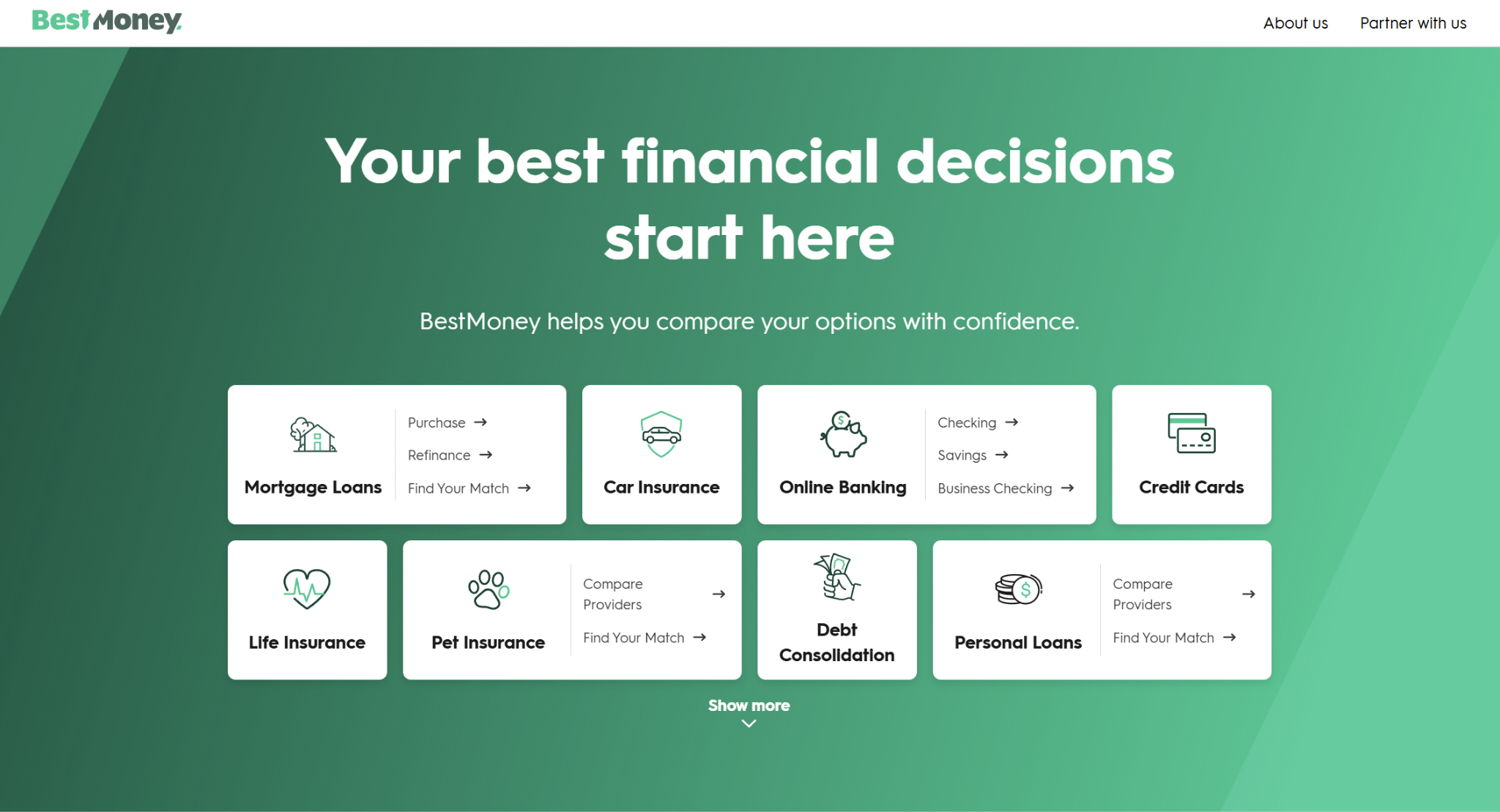
BestMoney is fairly similar to Bankrate; you can use it to broaden your knowledge on a range of products, from loans and insurance to HYSAs and credit cards.
Product Coverage and Filters
No matter what kind of financial product you’re interested in comparing, the odds are that you can use BestMoney to compare providers. For example, under the umbrella of insurance, you can explore options for car, life, pet, renters, home, travel, and business insurance. Bankrate, on the other hand, only shows car and home insurance.
For most product types, they have filters you can use to find providers that meet your requirements. So if you’re looking at personal loans, there are filters for loan purpose (debt consolidation, medical expenses, credit card consolidation, or other), loan amount, your annual income, and your credit score.
However, it doesn’t show nearly as many options overall. When looking at online savings accounts, they showed me nine options, while Bankrate showed me over 90. So while BestMoney won’t be the best tool for extensive research, it’s a great platform to explore when you’ve just started looking and don’t want to be overwhelmed by options.
Ratings and Reviews
BestMoney assigns an overall score out of 10 points for each provider, as well as reviewing them for factors like interest rates, loan terms, application requirements, and the customer experience.
One potential downside is that, unlike Bankrate, they don’t have a place for users to input their own ratings and reviews. So if you want the perspectives of fellow consumers, you’ll have to go elsewhere.
Financial Education
While BestMoney’s core purpose is to help you find the best provider or lender for your situation, it also has a library of articles you can explore to learn more about a topic. For some product types, it has interactive tools like calculators that you can use to estimate potential outcomes.
Pros
- Broad product coverage
- Editorial ratings and reviews
- Informative articles on personal finance
Cons
- No user reviews
- Provider options are limited
- No side-by-side comparisons
NerdWallet: Best for Financial Education

NerdWallet rivals Bankrate in terms of comparison features and finance expertise. It’s filled with resources covering most areas of personal finance, and it also has helpful guides for small business owners.
Product Coverage and Filters
NerdWallet covers several areas of finance, including credit cards, banking, loans, insurance, investing, and taxes — the latter of which is one major differentiator here, as they have reviews and head-to-head comparisons of tax software while Bankrate doesn’t cover tax products at all.
The site has plenty of best-of lists within each product category. For instance, if you navigate to the “best investment accounts” section, there are separate lists for the best brokerage accounts, robo-advisors, trading platforms, online brokers for beginners, Roth IRA accounts, traditional IRA accounts, and investing apps.
For some of their products, NerdWallet lets you use filters to narrow down your options, such as credit score, loan amount, and ZIP code. However, their more abbreviated list of providers means you may not even need to use filters.
Ratings and Reviews
NerdWallet’s team extensively reviews insurance companies, banks, and lenders, providing pros and cons lists, an overview of the customer experience, and an examination of product features. They also assign ratings out of a maximum of five stars, allowing for easy comparison across options.
Financial Education
Personal finance education is one of the areas where NerdWallet shines the most. Their breadth of articles dwarfs many of their competitors, and a lot of them are concentrated under the site’s “personal finance” section. The site covers topics like understanding your credit score, saving money, handling bills and expenses, and dealing with debt collection.
Beyond articles, NerdWallet has plenty of calculators to play around with. Some of their calculators are for broader areas of finance, like net worth and savings goals. Others are highly specific, like a mortgage amortization calculator and a balance transfer savings calculator.
Pros
- Broad product coverage
- Editorial ratings and reviews
- Plenty of calculators
Cons
- No user reviews
- No side-by-side comparisons
- Potentially confusing UI
WalletHub: Best for Credit Cards

WalletHub is another solid alternative to Bankrate, with a significant focus on credit cards.
Product Coverage and Filters
While you can use WalletHub to learn about a range of personal finance categories, they’re best known as a credit card comparison tool. This is clear from their wide coverage of specific credit cards, their credit score and credit analysis capabilities, and their CardAdvisor tool, which you can use to get personalized card recommendations. They also let you compare up to seven options at once, side-by-side.
However, if you want to compare lenders or banks, you can use WalletHub for that too. Their database is one of the most extensive; when I typed in my ZIP code to compare savings accounts, they gave me a list of over 1,000 banks to compare. This breadth of options can be helpful in many ways, but it could also be potentially overwhelming.
The good news is that along with the extensive list of options comes an extensive list of filters to use. For credit cards, for example, you can filter by card type, credit score, card network, balance transfer fee, foreign transaction fee, security deposits, and smart chip technology, among others.
Ratings and Reviews
WalletHub’s approach to reviews is heavily user-focused, though they do publish editorial reviews as well, giving you a well-rounded look at each option that balances real-world experience with expert guidance.
Financial Education
WalletHub does have some educational resources, but comparisons remain their top priority. Many of the articles are credit-related, addressing topics like interest rates, business cards, cash advances, and credit limits. However, for other topics like mortgages or banking, you may need to visit a different site.
One area where WalletHub excels is calculators that span most areas of personal finance, like mortgages, credit cards, student loans, auto loans, savings, personal loans, and retirement.
Pros
- Great for credit card comparisons
- Extensive filtering
- Side-by-side comparisons
Cons
- Potentially overwhelming number of options
- Some products are unrated
- Limited number of personal finance articles
Finder: Best for Cryptocurrency
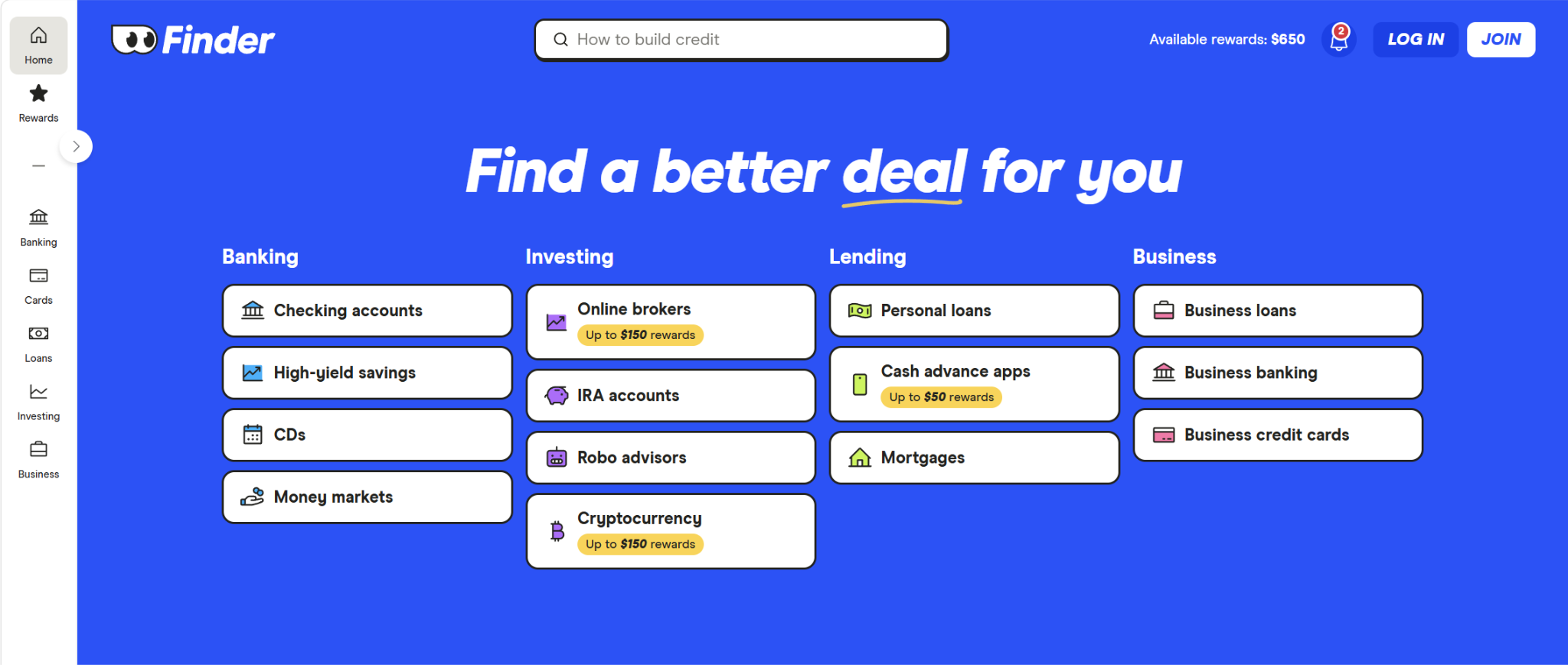
Finder isn’t as prominent a name as sites like NerdWallet or Bankrate, but they can still help you along your search for the ideal product. They do heavily promote exclusive deals for members, but you can access all of their comparison features without registering for an account.
Product Coverage and Filters
Finder has tools for comparing a variety of financial products, including banking, credit cards, loans, and investing. They also have resources for kids’ banking, but they also heavily focus on cryptocurrency exchanges and wallets. This is especially noteworthy, since most other comparison sites tend to avoid the topic of crypto entirely.
While Finder’s list of product options isn’t as extensive as something like WalletHub’s, they give you plenty of choices to explore. Within the credit card category, for example, you can filter by account features, deposit methods, and location. You can also sort the list according to your priorities, such as by APY, minimum balances, and minimum deposits. Once you’ve started to narrow down your top contenders, you can use their side-by-side comparison tool to compare up to four options at a time.
Ratings and Reviews
Finder assigns scores out of 10 points, but they also publish editorial reviews for many leading banks, credit unions, and lenders. There’s a section available for users to submit their own thoughts, though most products are currently unreviewed.
Financial Education
If you’re looking for resources to deepen your knowledge of personal finance topics, Finder has those too. There are detailed articles discussing topics like retirement, how to build credit, and how to purchase cryptocurrency. You can also use Finder’s calculators, such as their compound interest calculator or their debt consolidation savings calculator.
Pros
- Includes cryptocurrency products
- Extensive filtering
- Side-by-side comparisons
Cons
- Heavily pushes their rewards program
- Limited user reviews
- No insurance products
DepositAccounts: Best for Banking
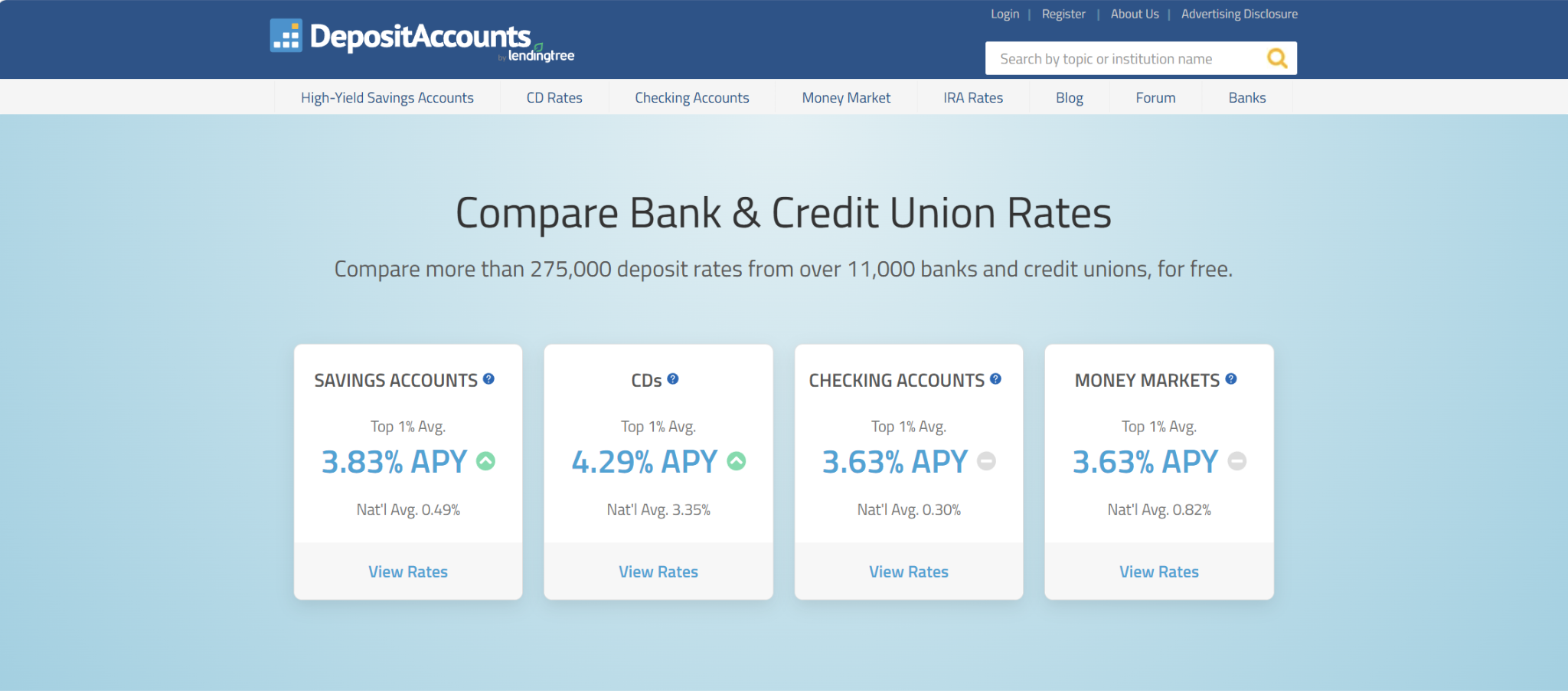
DepositAccounts is unique from most comparison sites in that they focus entirely on banking, choosing not to cover other financial products. However, this focus also means that they’re extremely thorough.
Product Coverage and Filters
DepositAccounts lets you compare savings, checking, CD, money market, and IRA savings accounts. Each category is broken down into subcategories that let you get highly specific in your search; for example, high-yield savings is subdivided into personal, business, health, installment, and children’s savings accounts.
The product choices are also extensive, with the site claiming that you can use it to compare over 275,000 deposit rates from over 11,000 banks and credit unions. This gives you an unfiltered view of what’s out there, but it can also be intimidating when beginning your search.
Fortunately, you can use filters to narrow down your list. For personal savings, you can input your location and deposit amount. You can choose whether you want to view banks, credit unions, or both, and you also have the option to hone in on local (rather than online) banks. Besides filters, you can also sort by APY, minimum balances, minimum deposits, and service charges.
Ratings and Reviews
DepositAccounts doesn’t publish full editorial reviews on banks and credit unions, instead providing a pros and cons list and assigning a star rating out of five. This rating combines separate scores for popularity, overall value, digital banking, customer satisfaction, and health.
But one area where DepositAccounts shines is with user reviews that let consumers write about their experiences. They also operate a community forum, where users can ask questions and discuss banking news like rate changes and promotional offers.
Financial Education
DepositAccounts has a blog, though it is fairly limited in nature, covering mainly banking news and consumer trends. Many of their articles are purely educational, discussing topics like the difference between a Roth and a traditional IRA, how a savings account works, and how to transfer money between banks.
Pros
- Extensive filtering
- User reviews
- Editorial bank ratings
Cons
- Only covers banking products
- No editorial reviews
- Limited number of personal finance articles
The Best Bankrate Alternatives: Final Verdict

While Bankrate is a strong, reliable financial comparison tool, it may not always have what you need. Fortunately, there are several alternatives you can use instead.
If you’re looking for something straightforward to use for quick research, BestMoney is your best bet. For banking, you might prefer DepositAccounts, while credit cards are WalletHub’s speciality. Ultimately, it’s always smart to conduct research on several sites before making a financial decision.