
If you’re dealing with significant high-interest credit card debt, a balance transfer may be a smart idea. This is when you move your existing credit card debt to a different card that has a lower interest rate. When used as intended, a balance transfer could help you pay off your debt over time without drowning in interest.
Balance transfers aren’t for everyone, though. If you’re able to pay off your debt quickly, say within two or three months, it’s usually more cost-effective to stick with your original card. On the other hand, if you expect it will take over two years to pay off your debt, you may want to consider consolidation or other debt management options instead. The same advice goes for if your debt is large or you have bad credit.
However, if your situation seems like it could benefit from a balance transfer, there are some important factors to weigh. Namely, differences in introductory offers and fees could make one card a better fit than another.
Here’s what really matters when comparing balance transfer credit cards.
0% Intro APR Periods

The main benefit of using a balance transfer card in the first place is to prevent you from accumulating further interest at high rates. Balance transfer cards typically come with a 0% introductory APR period, meaning that you won’t pay any interest on your debt during this time. The lengths of these periods can vary among cards. Most commonly, you’ll see them range from as short as six months to as long as 21 months.
Choosing a card with the appropriate intro APR period is one of the most critical decisions you can make. Often, longer is better, as this gives you more time to pay off your debt without incurring interest. If you sign up for a card with a short introductory APR period and can’t pay off your debt before this period ends, you’ll start incurring interest again. However, if you’re confident that you won’t need too long to pay off your credit card debt, a shorter intro APR term may not be a deal breaker.
Balance Transfer Fee
Most balance transfer cards charge you a fee for transferring your balance, which is usually between 3% and 5% of your debt. There may also be a minimum fee, with $5 being a common amount, for situations where 3% or 5% of your debt would be lower than this. A minority of cards don’t have a balance transfer fee, although these cards tend to have shorter intro APR periods and stricter credit score requirements.
Also, note that the balance transfer fee counts toward your credit limit, so be sure to factor this in when determining how much of your existing debt you can transfer.
Balance Transfer Savings Example: Balance Transfer Fee vs. Interest Paid

Suppose that you have $5,000 in credit card debt on a card with a 25% APR. You plan on paying off the debt in 12 equal payments over 12 months.
If you stay with your original credit card, your monthly payment would come out to be approximately $475 monthly, and the total interest paid would be approximately $703.
Instead, you transfer your debt to a card with a 12-month 0% intro APR for transfers and a balance transfer fee of 3%. Here, you wouldn’t pay any interest, as you would have paid off the debt in full by the end of the introductory period. The fee would be $150.
To calculate the savings, you would subtract the balance transfer fee from the total interest you would owe if you stayed with your original card. You would save approximately $553 by transferring your balance.
Regular APR
A credit card’s regular APR is the interest you will face on whatever debt is left during the introductory period. Most credit cards have a variable APR, meaning it can fluctuate along with federal economic policy. Compared to many other types of funding, credit card interest rates can be especially high, reaching 20% to 30% or more.
If you aren’t able to pay off your debt completely during the 0% APR promotional period, the regular APR will apply to your remaining debt, and you could face substantial interest costs. This is why it’s critical to consider the length of the introductory period.
A card’s regular APR can be relevant for reasons other than your balance transfer, though. If you plan on using the card in the long term, even after you’ve paid off your debt, it’s important to consider a card’s regular APR, as this is the rate you’ll face if you’re not able to pay off your balance in full every month. Look for cards with a lower APR than the one you are looking to transfer from.
Annual Fee

When choosing any credit card, consider its annual fee, as this can play a significant role in determining the overall cost of a card, and it can cut into any potential rewards. When considering a balance transfer, choose a card that does not have an annual fee. Since the goal is to pay off your existing credit card debt by moving away to a card with lower costs, prioritize cards that have both a 0% intro APR period and no annual fee. Choosing a card with an annual fee for a balance transfer could make it less likely that the transfer will actually benefit you.
Card Issuers
Most of the time, you can’t transfer one credit card balance to another card from the same issuer. For a balance transfer, you will need to choose a different issuer entirely. If you already have a relationship with a particular issuer, whether it be through a separate credit card or existing bank accounts, you might prefer to use that issuer for your balance transfer to keep more of your finances centralized. Some consumers prefer this because it reduces the number of logins you need to maintain and the number of financial institutions you’ll have to deal with.
Otherwise, some things you may want to consider are the customer experience and the card network’s acceptance. Visa and Mastercard are the most widely accepted, both in the U.S. and internationally, while American Express cards have the lowest acceptance. Most merchants still take American Express, but the rate is somewhat lower primarily due to its higher merchant fees.
Credit Limits
When you transfer your balance to a new card, you’ll be assigned a credit limit. This is the maximum amount that can be charged to your card. The debt you’re transferring, the balance transfer fee, and any purchases you make with the card all count toward the credit limit.
Your credit score, income, and existing debts play a major role in determining your credit limit. While good to excellent credit is typically required to transfer an existing balance in the first place, if your credit score is on the higher end, you might be able to access a higher limit.
Depending on your credit score, it’s possible that you could get approved for a credit limit that’s lower than the amount of debt you’re wanting to transfer. Here, you may need to resort in transferring only a portion of your balance, or you might want to look into personal loans instead.
0% Intro APR on Purchases

If you want to use your new credit card not only for a balance transfer but also for purchases, then you should check to see if there are any introductory APR offers for purchases as well. Cards with 0% APR periods for both balance transfers and purchases may use the same period lengths for both, or they may differ, so be sure to read the fine print.
Rewards
Cash back, points, and miles are all types of rewards that credit cards can offer. While rewards shouldn’t be your priority when transferring a balance, they can still be worth factoring in, especially if you plan to keep the card long-term.
Cash back rewards are the easiest to calculate, making them popular among those new to credit or who otherwise want a simple rewards structure. Cash back may be rewarded as a flat 1% or 2% rate across all purchases, or certain purchase categories may receive a higher rate. Some cards offer rotating categories as well.
Though similar, points and miles differ in that miles are more clearly tied to travel-related rewards like airfare, while you may have more redemption options for points. The value of both one point and one mile hovers around one cent, but it can fluctuate.
Welcome Bonuses
Beyond rewards, some cards also offer welcome bonuses for new cardholders. Usually, these involve receiving extra rewards if you make a certain amount of purchases within a specified amount of time. For example, you may see a welcome bonus of $200 additional cash back if you make at least $1,000 in purchases within three months.
Some consumers frequently open and close credit cards to take advantage of welcome bonuses, a practice known as churning. While potentially beneficial, many card networks have established restrictions on the number of cards you can open within a short period of time to combat this. It can also affect your credit score, so be mindful of this.
Using Balance Transfer Credit Card Comparison Sites
Because finding the best balance transfer card largely comes down to the length of the 0% APR promotional period, along with the balance transfer fee, it’s critical to compare several options to find the optimal fit.

One of the most efficient methods for comparing multiple card characteristics at once is to use a credit card comparison site. These sites let you filter for balance transfer cards, allowing you to view APRs and fees side by side. Many of them also have a balance transfer savings calculator, helping you get an idea of just how much you could save. Some popular examples include BestMoney, NerdWallet, WalletHub, and Bankrate.
While card coverage can overlap across sites, each has its own partner network of featured cards. Because the scopes can differ, it’s a good idea to visit more than one site during your search to get a well-rounded view of your options.
Start Comparing Balance Transfer Cards Today
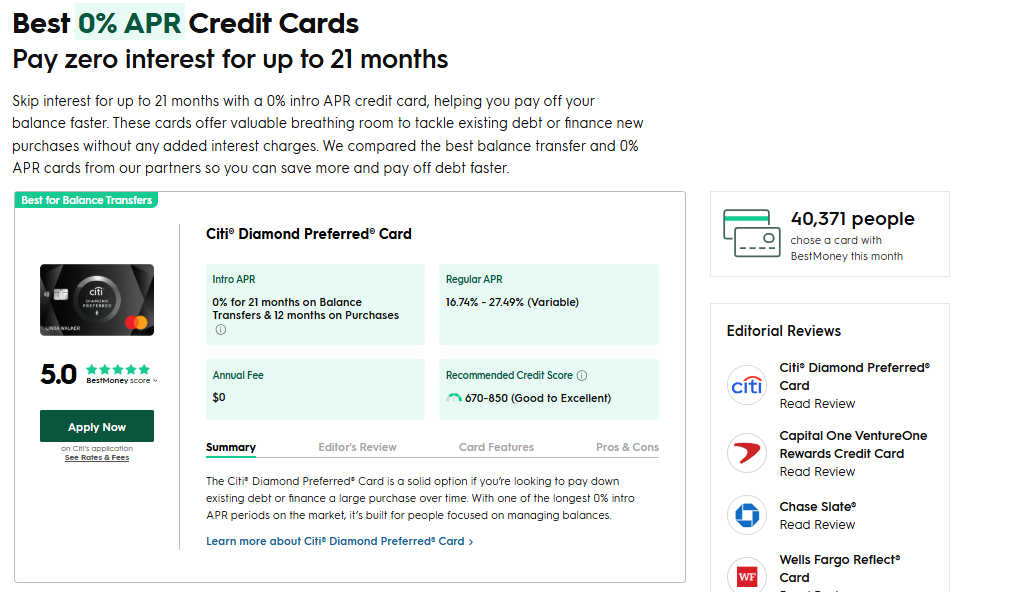
A high interest rate can make it increasingly difficult to pay off your credit card debt, which is why transferring your balance to a lower-rate card, often with a 0% APR introductory period, can be a wise decision.
When comparing introductory periods, think about how long you realistically expect it to take you to pay off the debt. To benefit from a balance transfer card, you’ll want to pay off the balance before the promotional period is up. Also, compare balance transfer fees, as these can eat into your savings and count toward your credit limit. And if you plan to use the card for purchases as well, factor in any rewards, welcome bonuses, and introductory purchase APRs.
Take your time comparing balance transfer credit cards to have the best chance of tackling your debt.